
Recommendations in a joint consensus statement published by HRS in Heart Rhythm provide clinicians with updated guidance to reduce clinical challenges and morbidity within a rapidly evolving technological landscape
April 23, 2026 – New evidence on cardiovascular implantable electronic devices (CIED) lead management and the burgeoning development of new CIED technologies have contributed to the field’s rapid evolution in the last decade. The new “2026 HRS/AHA/APHRS/EHRA/IDSA/LAHRS/PACES/STS Expert Consensus Statement Update on Cardiovascular Implantable Electronic Device Lead Management and Extraction” in Heart Rhythm, the official journal of the Heart Rhythm Society, the Cardiac Electrophysiology Society, and the Pediatric & Congenital Electrophysiology Society, published by Elsevier, details the latest recommendations aimed at guiding clinicians and patients in choosing the right device and managing it over time to reduce complications and support better quality of life.
When AF occurs, the heart beats irregularly and the risk of stroke, heart failure, and other cardiovascular complications are all increased. More than 40 million people worldwide live with AF, and in the United States alone, approximately 454,000 hospitalizations each year are associated with the condition.i,ii As new uses and benefits of GLP-1-RAs continue to emerge, researchers increasingly wanted to understand whether these therapies could help prevent AF or treat it. GLP-1-RAs are widely prescribed to treat type 2 diabetes and obesity and also are known to improve cardiovascular health, in part through weight loss. However, it is unclear whether their potential benefits for AF are primarily driven by weight reduction or whether the medications may have additional independent cardiovascular effects.
Over the past 70 years, CIEDs have become an established treatment option for selected patients with bradycardia, tachycardia, and heart failure. It is estimated that in 2022, 800,000 CIEDs were implanted in the United States. Future CIED implant rates are expected to be higher due to the global aging population, particularly for permanent pacemakers.
CIEDs traditionally use leads that connect the pulse generator to cardiac tissue. Since the publication of the “2017 HRS Expert Consensus Statement on Cardiovascular Implantable Electronic Device Lead Management and Extraction,” the field has evolved quickly with the publication of new evidence on CIED transvenous lead management, development of new CIED technologies that are leadless or use leads implanted outside the vascular system, wide adoption of leads that do not have a lumen, new lead extraction tools, and new cardiac and vascular procedures that have lead management implications.
“A holistic approach to CIED selection and use is required, as is, by extension, consideration of potential lead management implications over a patient’s lifetime,” notes Yong-Mei Cha, MD, FHRS, Mayo Clinic, Rochester, and Chair of the Writing Committee. “The document we present today is intended to help clinicians in their decision-making process for managing leads and CIED implant considerations and updates the 2017 expert consensus statement.”
The consensus statement’s writing committee consisted of internationally recognized experts from five countries in the fields of clinical electrophysiology, pediatric electrophysiology, cardiothoracic anesthesiology, cardiothoracic surgery, and infectious diseases representing multiple professional societies. They systematically reviewed scientific evidence and translated their findings into recommendations to improve the quality of care in CIED lead management. This current expert consensus statement focuses on providing an update on practical clinical guidance in the broad field of lead management, including extraction and management of traditional CIEDs that use transvenous leads, CIEDs with extravascular or subcutaneous leads, and leadless CIEDs.
The new recommendations address the latest CIED technologies with advantages over transvenous leads, new evidence supporting diagnosis, treatment, and prevention for CIED infection, appropriate lead management in transcatheter tricuspid valve replacement for tricuspid regurgitation, and standardization of transvenous lead extraction approach, protocol, and facilities to improve the outcomes of CIED lead management and extraction.
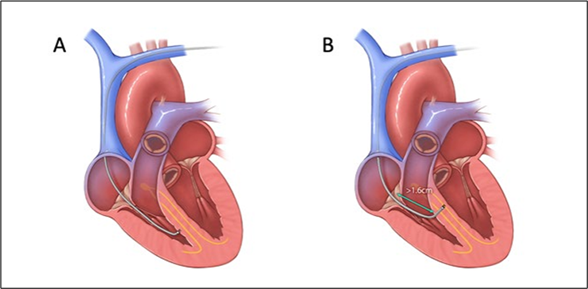
A new global consensus statement published in Heart Rhythm establishes a blueprint for holistic cardiac device implantable electronic (CIED) lead management and more tailored treatment options for patients. This image depicts the right ventricular lead positioning relative to the tricuspid valve. (A) Placement of leads on the right ventricular septum (versus apical pacing) has not been associated with worsening tricuspid regurgitation. (B) When implanting leads for left bundle branch area pacing, a shorter lead to tricuspid annulus distance can result in more tricuspid regurgitation. (Credit: Heart Rhythm / Cha et al.)
“Newer technologies in CIED offer the potential to decrease the clinical challenges and morbidity associated with intravascular devices. Since the 2017 consensus statement, the use of leadless pacing and non-vascular implantable cardioverter defibrillators has increased substantially, ushering in a new paradigm of non-vascular cardiac rhythm management,” says Dr. Cha.
She concludes, “Future lead management considerations must be taken into account when any CIED—including leadless pacemakers—is implanted. At initial CIED implant or subsequently when a generator or lead needs to be replaced or revised, device choice and lead management issues include clinical indication, patient comorbidities, predicted patient lifespan, lead performance, consequences of any future CIED complication, and potential clinical benefit and risks. This collaborative approach ensures that device and lead selection and management strategies align with the patient’s long-term health, personal preferences, and quality of life to optimize outcomes over time.”
Notes for Editors
“2026 HRS/AHA/APHRS/EHRA/IDSA/LAHRS/PACES/STS Expert Consensus Statement Update on Cardiovascular Implantable Electronic Device Lead Management and Extraction,” by Yong-Mei Cha, MD, FHRS, Mikhael F. El-Chami, MD, FHRS, Christopher F. Liu, MD, FHRS, Laura J. Andreychuk, BSN, RN, Thomas M. Beaver, MD, MPH, Kelly M. Bergen, MSN, AGACNP-BC, FHRS, CCDS, Charles I. Berul, MD, MS, FHRS, CEPS-P, Ulrika Maria Birgersdotter-Green, MD, FHRS, Alexander Breitenstein, MD, Laurence M. Epstein, MD, FHRS, Jay N. Gross, MD, CCDS, Larry R. Jackson II, MD, MHSc, FHRS, Saima Karim, DO, FHRS, Andrew D. Krahn, MD, FHRS, Fred Kusumoto, MD, FHRS, Nigel Lever, MBChB, FRACP, Latoya N. Linton-Frazier, MD, MS, Charles J. Love, MD, FHRS, CCDS, Douglas Y. Mah, MD, FHRS, CEPS-P, Pamela K. Mason, MD, FHRS, M. Travis Maynard, Melanie Maytin, MD, FHRS, Jay A. Montgomery, MD, Jennie Ngai, MD, FASA, Ratika Parkash, MD, MS, FHRS, Kristen K. Patton, MD, FHRS, Naga Venkata K. Pothineni, MD, Ulises Rojel-Martínez, Sr., MD, FHRS, and M. Rizwan Sohail, MD, FIDSA (https://doi.org/10.1016/j.hrthm.2026.04.015). It appears online in Heart Rhythm, published by Elsevier.
The article is freely available at https://www.heartrhythmjournal.com/article/S1547-5271(26)022264-2/fulltext.
Full text of the article is also available to credentialed journalists upon request; contact Jane Grochowski at +1 406 542 8397 or [email protected]. Journalists wishing to speak to the authors should contact Yong-Mei Cha, MD, FHRS, at [email protected].
The Heart Rhythm Society (HRS) has developed expert consensus documents that have guided clinical care in the management of cardiac arrhythmias since 1996. This HRS-led expert consensus statement was jointly developed by the American College of Cardiology (ACC), the American Heart Association (AHA), the American Society of Anesthesiologists (ASA), the Asia Pacific Heart Rhythm Society (APHRS), the European Heart Rhythm Association (EHRA), the Infectious Diseases Society of America (IDSA), the Latin American Heart Rhythm Society (LAHRS), the Pediatric and Congenital Electrophysiology Society (PACES), and the Society of Thoracic Surgeons (STS).
###
About Heart Rhythm
Heart Rhythm, the official Journal of the Heart Rhythm Society, the Cardiac Electrophysiology Society, and the Pediatric & Congenital Electrophysiology Society, is a unique journal for fundamental discovery and clinical applicability. It integrates the entire cardiac electrophysiology (EP) community from basic and clinical academic researchers, private practitioners, engineers, allied professionals, industry, and trainees, all of whom are vital and interdependent members of our EP community. www.heartrhythmjournal.com
About the Heart Rhythm Society
The Heart Rhythm Society is the international leader in science, education, and advocacy for cardiac arrhythmia professionals and patients and is the primary information resource on heart rhythm disorders. Its mission is to improve the care of patients by promoting research, education, and optimal healthcare policies and standards. Incorporated in 1979 and based in Washington, D.C., it has a membership of more than 9,000 heart rhythm professionals from 94 countries. For more information, visit www.HRSonline.org.
About Elsevier
Elsevier is a global leader in advanced information and decision support. For over a century, we have
been helping advance science and healthcare to advance human progress. We support academic and
corporate research communities, doctors, nurses, future healthcare professionals and educators across 170 countries in their vital work. We do this by delivering mission-critical insights and innovative solutions that combine trusted, evidence-based scientific and medical content with cutting-edge AI technologies to help impact makers achieve better outcomes. We champion inclusion and sustainability by embedding these values into our products and culture, working with the communities that we serve. The Elsevier Foundation supports research and health partnerships around the world.
Elsevier is part of RELX, a global provider of information-based analytics and decision tools for professional and business customers. For more information, visit www.elsevier.com and follow us on social media @elsevierconnect.
Related Posts

Press Releases
Multicenter Study Finds Ultra-Low Temperature Ablation Highly Effective for Ventricular Tachycardia
April 26, 2026
Press Releases
New Study Shows Catheter Ablation Reduces Ventricular Tachycardia Events in Underrepresented Patient Population
April 26, 2026
Press Releases
Apple Watch Captures More Pediatric Arrhythmia Events Than Traditional Patch Monitors
April 25, 2026